Feeds:
Posts
Comments

To Learn is to Live

Two violins in my workshop this week suggest a topic of study that was addressed recently by the membership of the American Federation of Violin and Bow Makers. Lectures and a collection of instruments for study at the biannual meeting (this year in New Orleans) centered on the influence of the Amati family of makers (17th century), of Cremona, Italy, on contemporary and subsequent makers throughout Europe. Think population centers and European trade routes c. 1700 and one can begin to imagine how instruments may have moved around along with other goods. It’s become clear that the early  Amati models not only made the journey, but were so highly regarded that violin makers throughout Europe copied them.

The first is a violin made by Andrea Guarneri in 1686. I believe it is generally accepted that A. Guarneri, patriarch of the Guarneri family of makers, probably studied first in the workshop of Giralomo and Antonio Amati and then later, in Nicolo Amati’s shop (nephew of G and A). It’s also possible that Antonio Stradivari studied with him there. In any case, it’s obvious that the work of Andrea Guarneri would show the influence of the Amati shop. In the example that happens to be in my shop now, probably the most striking similarity, is the classic geometrically derived model, and the shape of the arching. I had the additional fortune this week of seeing a violin by AG’s eldest, Peter Guarneri of Mantua. Very similar arching, but with a broader, longer, more robust outline. I think the axiom that is evident here (and is true for modern makers as well) is that the best makers do not work in isolation, but build upon the ideas of their predecessors, and even their contemporaries.

So Andrea Guarneri was a local boy working in or near the Amati shop. That all makes sense. But what is more amazing to me is that 1179km away, by modern standards thank you googlemaps, and 50-60 years later, we have Peter Rombouts in Amsterdam making an instrument with an Amati influence. Now Mr. Rombouts married the lovely daughter of violin maker Hendrick Jacobs, whose work was also influenced by the Amatis. Did they have a client in common with a superb example worth studying? Were they “following the money” and answering a demand for Cremonese modeled instruments? Did they recognize an efficacious development in design and tone and seize the opportunity to advance their own work??

Who knows?

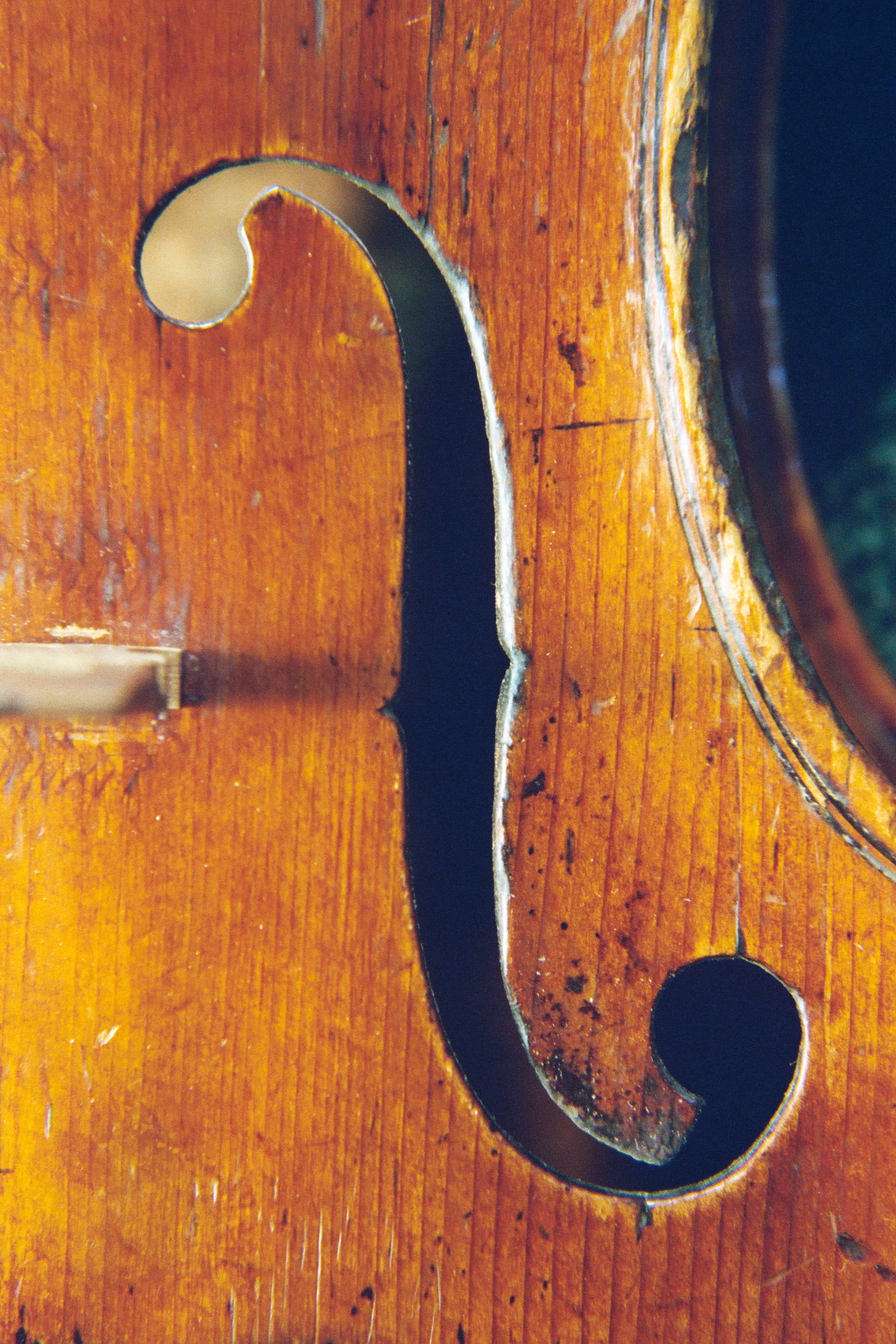
For the sake of reference, I’ve dug up a few shots of a 1656 Nicolo Amati violin that I see fairly regularly.  It’s a lovely instrument, exquisitely crafted with all the delicacy one expects from this maker. See the photo at the left and then compare it to this Peter Rombouts from Amsterdam, early 1700’s, on the right.  It’s so hard ( for me) to get effective photos of archings, so here are the ff holes. There are obvious differences, but I hope the similarities in geometry and placement will be evident. If you imagine the “eyes” on the Rombouts enlarged, you come pretty close to the Amati.
Again, a detail in the back corners. The Rombouts corner is quite worn, but still elongated like the Amati example on top. So not Strad.

The Rombouts is having some extensive work done in my shop, which provides a segue into one reason I care about any of this stuff.

As I approach the end of this particular restoration project, I am faced with the possibility of rebuilding some badly worn top corners. The back corners are somewhat worn, but overall, beautifully intact. However, the top corners, only two of which are original, are terribly worn down. Obviously, the back corners will be my primary reference, but as I am trying to recreate the missing bits, having a sense of the larger picture and understanding more about the derivation of Rombouts’ design can only help me.

Above, one can see that the top edges have been fully doubled. I have made a tracing of the back C bout/ corners and shaped the new top wood to this outline. Below, I have cut away the worn wood around the purfling (which is whale baleen by the way, in the manner of this Dutch maker) and added new wood to the outline. From here, I will do some further shaping to emulate an appropriate wear pattern. The “new ” wood I’ve used is very old and heavily oxidised, so hopefully it will require a minimum of retouching to match.

I realize that I have written next to nothing about violin restoration so far. Oh well. Most of my friends and family think I only work (and work) which is pretty much the way it is if you are self-employed and not married to a software engineer. If I’m missing something, please enlighten me.

I love photography, and have had romances with many cameras. But these days, cameras are fickle and so quickly become passé, even before you have the chance to really get to know them. Maybe I am old school, but I am suspicious of things that are meant to be thrown out before they are broken.

There’s another post here in the works, I can tell, so I’ll stop here, my point being that  – What do I take pictures of? Work, mostly!

And so this is really a post about gardening. It’s the thing I enjoy most that doesn’t really have anything to do with work. Although, I could easily extrapolate a connection…perhaps some other day.

I purchased this house in summer of 2010 and this is what the back yard looked like:

I employed Nancy Howard Landscape and Design to help me get started. Nancy got Mike to come in with some machines to remove a broken up old cement area, and to push some dirt around.

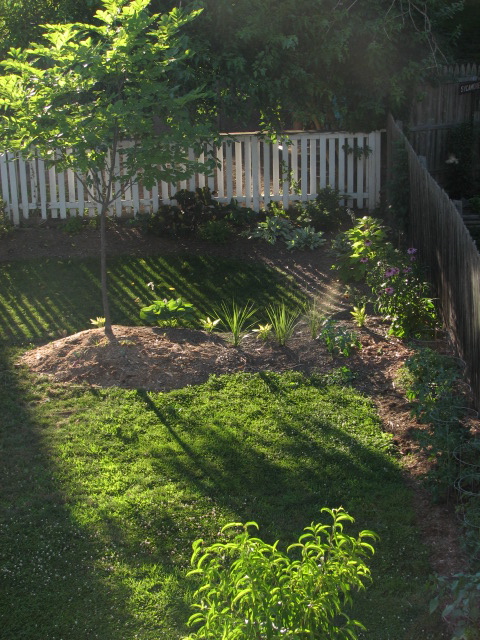
We went shopping, and on  Nancy’s recommendation, came home with  a Yellowwood tree and some beautiful foundation plants. By the end of the summer of 2011, my back yard looked like this:

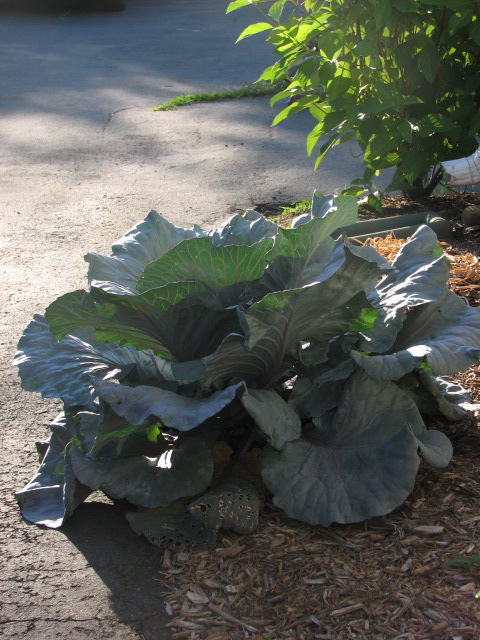
So this is how I’ve been spending most of my non-work time (notice I didn’t say “free”). On this first day of July 2012, in addition to further work in the shady area by the back fence, I have made three vegetable beds w bush beans, eggplant, tomato, basil, peppers, tomatillos, cabbage, lettuce and brussels sprouts. There are rhododendrons on the NE side of the house now and as of a few weeks ago – a pink dogwood, viburnum and weeping cypress in the front. And more veggies and flowers along the driveway.

It’s happening! It’s feeling like a place. I sit frequently out by the Yellowwood and wonder what it will look like in 50 or 100 years. My kind of time frame. I know…! In the meantime Bailey and I are both happy with the daily dose of fresh lettuce and kale, with the promise of more things to come.

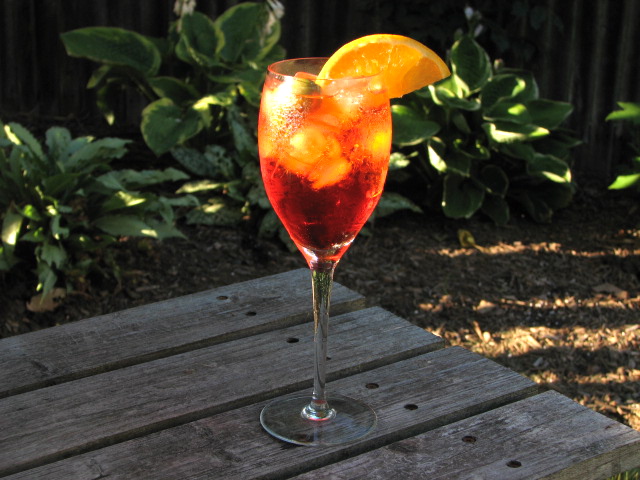
Say Aperol Spritz!

Possibly the best thing I ever brought home from my visits to Italy:

I had my first spritz in Venice, in a bar at Piazza San Marco. I observed city workers in yellow safety gear and large rubber boots stopping in after their day’s shift to down a tall icy wine glass full of something I had to try. I was traveling solo and so it was all up to me to make this educational experience happen. I was motivated.

Some kind of sketchy Italian combined with some sketchy English and a few minutes later I had myself an Aperol spritz and a new best friend. I had opted for bitter, rather than sweet and I’m still not sure what the sweet option would be – maybe Campari, or maybe more of what I was offered on the train platform in Florence (that’s another story)!

I’m a little embarrassed that I’ve had to (cough!)google the proportions of Aperol, prosecco and seltzer. Then there is the issue of a slice of orange? like I had in Venice? or a green olive, as is recommended in some foody travel blog I read once (maybe they know something)? Personally, I prefer both. A slice of orange grabs your nose as you go for the dive, and the olive is that opening to another dimension as you come up for air.

By the way, a spritz is readily available in Cremona as well (this is a violin related blog), where I’ve had it served in the early evenings with a bowl of pistachios and/or a bowl of potato chips. I think it’s a northern Italian thing. Say “Aperol spritz, per favore”.

2 oz prosecco

1 1/2 oz Aperol

dash seltzer

orange slice, green olive and lots of ice

*note: be sure to add the Aperol last, after the seltzer and prosecco so that it diffuses nicely in the glass, rather than sitting at the bottom.

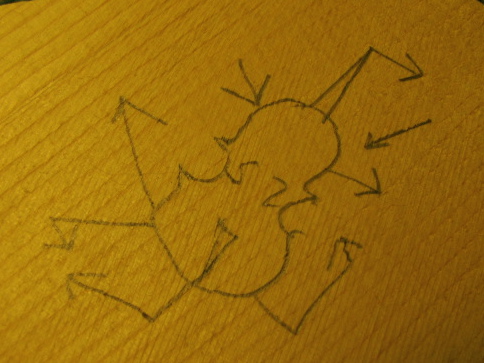
This is an image painted on a sidewalk in Budapest. It directs pedestrians to a nearby violin shop. It also reminds me of what just happened here this week. It’s actually been really quiet for a month or so, which is it’s own kind of nice. This week, all that changed.

Musicians are always going somewhere. But this time of year, it seems they move en masse. As professionals, students, and amateurs, they participate in summer residencies, music camps, summer concert tours and seasonal music venues. Sometimes it means some serious traveling and the accompanying climate related woes. There is always the  general anxiety surrounding the possibility of developing a problem and not knowing where to have it remedied.

I am situated about halfway between Boston and the Berkshires, just north of Connecticut and on the way to Vermont and New Hampshire. So far this week, I’ve fielded calls from faculty and students at BU Tanglewood Institute http://www.bu.edu/cfa/tanglewood/ including one young cellist that came from Paris and discovered the seams on her cello had opened up in filght, rendering it impossible to play (she picked up her happy cello this am). I’ve had people get off the plane at Bradley Airport and stop here on their way to Greenwood Music Camp www.greenwoodmusic camp.org or Marlboro Music Festival www.marlboromusic.org.

And then there are my regular clients, also preparing to perform, study and teach – you got it – elsewhere! Apple Hill Center for Chamber Music  www.applehill.org, Monadnock Music www.monadnockmusic.org are among the places they will be going this summer. By the way, all of these places have musical events that are open to the public. I hope to get to at least a few.

Might as well start

with a BANG!

Thunderstorms in the area mean the two cats are huddled on the cellar stairs and the dog is warming my feet. The dog will continue (or at least try) to warm my feet even as I walk about the shop, so clearly, the only thing to do is stay put and write while this thing blows over.

Today I launched my first ever website and blog – after being in business for 17 years. I am a professed Luddite, so this is a big deal.

I repair and restore violins, violas and cellos for a living. I love what I do. It’s wildly interesting, visually beautiful, historically fascinating AND dovetails eloquently with other luscious areas of human endeavor like music performance and fine art and craft.

I’ll be posting lots of photos. Maybe I’ll cover some interesting repair procedures or highlight an instrument I’m working on. Otherwise, you’ll find the sometimes serious, sometimes humorous and occasionally irreverent take on things that catch my attention, busy my brain and occupy my hands.